Financial Planning Process - Steps of Financial Planning- Axis Direct
Dec 24, 2019 | Source: AxisDirect-O-Nomics
Best ways to chalk out a financial plan for a better and brighter future
The views and opinions expressed are of Mr. Arun Thukral, MD & CEO, Axis Securities.
If you’re interested in getting better at money management, what you need is a good financial plan. When done right, planning your finances can help you achieve your short-term goals as well as long-term objectives. However, most people tend to skip over some crucial steps while creating their financial plan. If you’re keen on avoiding this costly mistake, you’ll need to understand the essential elements of financial planning. Here’s how you can make a blueprint that can secure your future financially.
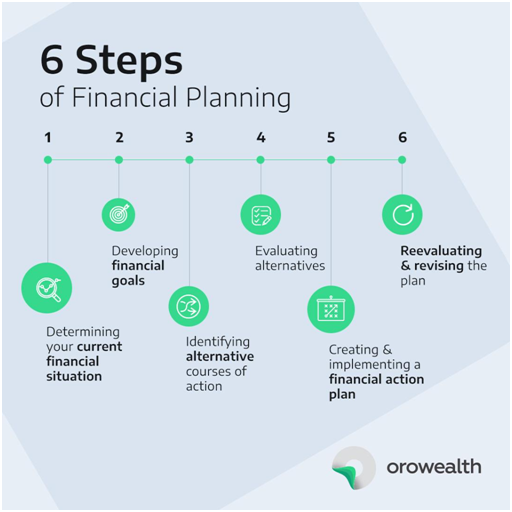
Source: orowealth.com
Identify your financial goals
The first step to chalk out a financial plan that can make your future better is to identify your financial goals. This includes both short-term and long-term objectives. List out your goals and write a concrete deadline against each entry. Based on the time you have left to accomplish these targets, classify them as short-term and long-term goals. Doing this can clear your perspective and give you a better look at the larger picture.
Work out your budget
Your budget determines the amount of money you have at your disposal. So, once you’ve set your financial goals, draw up a comparison of your income and your expenses. When you write out the costs, include all fixed expenses like internet bills, rent, and EMIs. Once that’s done, make an estimate for the variable costs like electricity expenses, travel outlays, and impulse purchases, among other things. The balance is what you’ll have to save and invest.
Analyze various investment instruments
Once you know what’s available for investments, you’ll need to compare various investment options. Your investment choices need to align with your short-term and long-term financial goals. They also need to be in tune with your risk appetite. With Axis Direct, you can compare and choose from multiple investment instruments with varying degrees of risk. For the risk-averse investor, there are options like Kisan Vikas Patra, Public Provident Fund, and savings bonds. For the bolder and more risk-seeking investor, Axis Direct offers many investment options like mutual funds, SIPs, and commodities, among others.
Look at tax-saving investment options
While you’re at it, consider parking your money in investment options that help you save tax in the process. The Income Tax Act, 1961, has several provisions that allow you to claim deductions on expenses or payments related to certain investments. For instance, if you’re risk-averse, you could consider investing in tax-saving fixed deposits. Alternatively, if you’d like to take a less conservative approach and also enjoy tax benefits in the process, you could consider options like equity-linked savings schemes (ELSS). By investing in these instruments, you receive a two-fold advantage; you get to save on taxes, and your money grows over the years.
Build a healthy portfolio
The key to investing smartly is to build a diverse portfolio. Having too many low-risk investments may dampen the rewards you earn in the long run. On the other hand, investing heavily in high-risk instruments could wipe out your savings overnight, in case of a financial or an economic crisis. The secret to help your money grow lies in balancing the two. Diversify your portfolio by choosing different investment options that fit in with your long-term goals.
Tackle debt smartly
If you already have a debt or two to your name, focus on paying them up before you decide to park a significant sum in investments. Paying your debts on time can help you in two ways. Firstly, once you’ve paid your EMIs, you have more money for investments. Secondly, prompt repayment of debt improves your credit score. This way, if you’re ever in need of a loan later in life, it’s easier for you to borrow. If you’re portfolio doesn’t include any debts, be prudent about borrowing money.
Be flexible about your plan
Once you’ve laid out a blueprint, leave room for essential modifications in the long run. Factors like market situations and inflation rates may require your plan to be revised and adjusted to help you achieve your goals. A plan that’s too rigid could leave you at a disadvantage in case of an emergency or untoward happening. It’s essential to periodically go over your financial plan and modify the areas that need to be better aligned with your objectives. Doing this helps you stay with the times and allows you to adapt as the financial situation changes.
By following these steps, you can prepare a financial plan that will help you increase your wealth and secure your future. The key is to understand that there’s no one-size-fits-all solution for creating a financial blueprint. Your investment strategies and saving habits need to be capable of meeting your specific financial objectives. So, understanding what you want to achieve financially is the foundation for coming up with a plan that’s right for you.
vV5.0.0.6-60
Thanks for Liking, Please spread your love by sharing...
As you have logged in from a different device/browser. This session has
expired.





 INDIA
INDIA NRI
NRI