How to make sure your tax-saving exercise is in line with your life goals
The views and opinions expressed are of Mr. Arun Thukral, MD & CEO, Axis Securities.
Investing in the financial markets doesn’t end with just parking your money in the right place; it’s only half of the story told. The other half is about protecting your investments by minimizing risks or diversifying. The market provides you with tools to do that and one of the most effective ones are derivatives.
Derivatives are like insurance products. It not only allows you to protect your investments; it also gives you an opportunity to generate profits. Derivatives derive their value from the underlying asset such as stocks, currencies, bonds, market indices or commodities. Futures and options are the most popular derivative products among traders and investors. They not only provide investment protection but also give you the opportunity to profit from the movement of the underlying asset.
If you are planning to explore the derivative segment for hedging, additional income or diversifying your portfolio, here’s a primer on Futures and Options from Axis Direct to get you started.
Futures & Options
Though both futures and options are derivative products, they are quite different in their features and characteristics.
What are Futures?
A futures contract involves two parties who agree to buy or sell a predetermined quantity of a particular asset at a specific price at a future date. Futures are traded in future exchanges and some examples include crude oil futures, gold futures, stock index futures, currency futures, bond futures and interest rate futures.
Every futures contract has an expiration date and the buyer has to buy or the seller has to sell the underlying asset after the expiration date. If you are buying a futures contract, you are taking a long position and if you are selling it, you are taking a short position.
Example of a commodity futures contract
Assume you are a farmer who cultivates and sells wheat. You expect to produce 1000 tonnes of wheat next year. However, you expect the price of wheat to fall next year due to a bumper crop but you want to ensure that you get a fair price for your harvest. So, you buy a futures contract to sell wheat at a specified price in April next year. If the price of wheat falls down, you will still be able to make a decent profit by selling it at the predetermined price.
However, if the price of wheat surges way more than what you have agreed to sell, you will be missing on a huge profit. This is an example of hedging in commodity where you actually have a physical product or underlying asset to sell and you want to protect yourself from falling prices.
But you don’t have to necessarily buy or sell a product when you enter into a commodity futures contract. For example, a speculator who profits by speculating the price direction of wheat can make a profit without selling or buying wheat. If he rightly predicts and buys a wheat futures contract and the price of wheat increases, he will be able to make a profit by selling the wheat futures at a higher price.
What are Options?
Options are derivative contracts that give an option buyer the right to buy or sell a specified quantity of an underlying asset at a predetermined price and date. A buyer in an option has the right but is under no obligation to buy or sell the underlying asset.
There are two types of options:
Call options: A call option gives you the right to buy an underlying asset such as stock, currency, bond, etc. at a specified price within a specific timeframe known as the expiration date.
For example, a call stock option quote may look something like this:
ABC December 17, 2019 700 CALL at Rs. 50
In the above example, ABC is the name of the underlying asset or stock and December 17, 2019 is the day when the Call option expires. Rs. 700 is the strike price, which means that the buyer has the right to buy the stock at Rs. 700 before December 17, 2019. Call is the type of option and Rs. 50 is the per-share cost or premium that you need to pay to buy the option. Option contracts are usually available in lots of 100. So, in that case, you will have to pay a premium of Rs. 5,000 to buy the call option.
Remember, the price of an option is only a fraction of the real cost of the underlying asset. That’s why it is considered an effective tool for leveraging your profits or protecting your investments.
Put options: A put option gives you the right to buy an underlying asset such as stock, currency, bond, etc. at a specified price within a specific timeframe known as the expiration date.
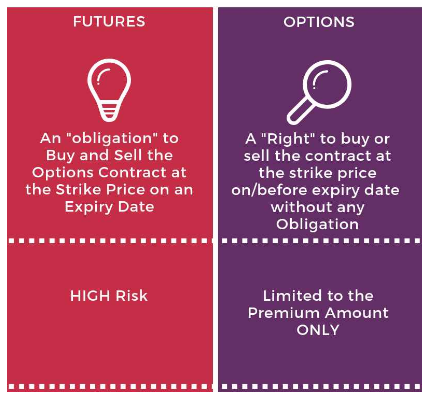
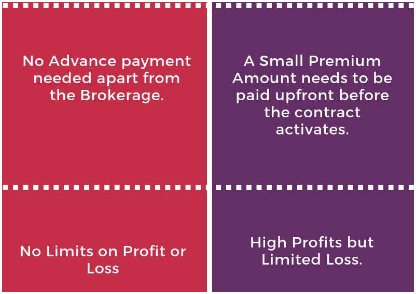
Futures vs. Options
MAJORDIFFERENCES
Source: ADigitalBlogger.com [2]
If you know what you are doing, both futures and options are great tools for hedging (protection), speculation (profiting) and diversifying your investments. Whether you are new to the world of investing or a seasoned investor, Axis Direct’s 3-in-1 Savings, DEMAT and Trading account opens up investment avenues to the world of derivatives, stocks, IPOs, mutual funds, ETFs and much more! If you find the equity and derivative markets as intimidating, Axis Direct also has market experts to guide you through every step of the process and ensure that you maximise your returns on every investment.





 INDIA
INDIA NRI
NRI